

One woman’s name appears on an early printing of the Declaration of Independence. Why?
Every July 4 Americans celebrate the approval of Declaration of Independence. But the fifty-six names that follow the text, most famously the bold signature of John Hancock, were not affixed to the document until August 2. To sign was a radical act. Each delegate in effect authorized his own arrest warrant (or worse) as a traitor to the British Crown.
A Revolutionary Woman
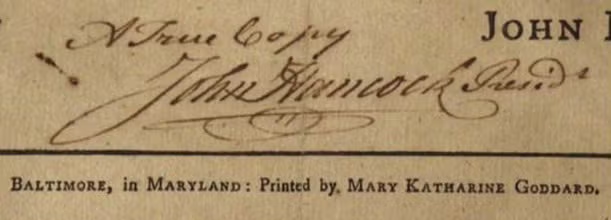
No woman’s name was among those original signatories. But in 1777 congress commissioned Baltimore printer Mary Katherine Goddard (1738–1816) to typeset and print the first copy of the Declaration to include the names of its signatories. At the bottom of each printed page, she proudly added the phrase—”Printed by Mary Katherine Goddard.” More typically, Goddard signed her name in print as simply “M.K. Goddard,” obscuring her sex by using only her initials.
Written for female vocalist and orchestra, Pressing Truths (2026) by composer Michelle Isaac revisits Goddard’s story and helps recover a forgotten figure of America’s Revolution. Goddard, as editor of the Maryland Journal newspaper in Baltimore from 1774–1784, reported on the Revolution’s early battles and raised her own voice in editorials calling for American independence from Britain.
In 1775, she became postmaster of Baltimore, likely making her the first woman to hold such a post in the colonies. Thus, when the British threatened to attack Philadelphia in December 1776 and the Continental Congress relocated to Baltimore, Goddard became responsible for handing all official mail to and from the delegates. She quickly earned their trust.
Victory Leads to Opportunity
In December of 1776, the momentum of the Revolution shifted. Following a string of defeats, George Washington led the Continental Army to a pivotal victory at Trenton, famously crossing the icy Delaware River to rout the British garrison in a surprise attack. Hoping to capitalize on this newfound momentum and remind Americans of what they were fighting for, Congress commissioned Goddard to print a new copy of the Declaration. For the first time, it would reveal the names of the Declaration’s signatories. To the names on this edition, Goddard added her own.
Yet after printing that “all men are created equal,” Goddard would experience the limits of these words. After the Revolution had been won and the U.S. Constitution ratified, Goddard’s position as Baltimore’s postmaster, become a federal post. This made Goddard in all likelihood the nation’s first female employee, yet it also exposed her to political malfeasance. Adding risk to her position was its increasing importance. At this time, Baltimore was a growing seaport and the young nation’s fifth largest city. Being postmaster there was an increasingly influential and lucrative position.
Goddard was fired in 1789, not long after her job was federalized, becoming one of the nation’s first victims of political patronage. Postmaster General Samuel Osgood appointed an ally as Baltimore’s postmaster instead. The official reason for her dismissal was “for want of a man,” as Osgood claimed that the job now required “more traveling… than a woman could undertake.” Some 230 citizens of Baltimore sent multiple complaints to Osgood asking to reinstate her. Goddard even petitioned George Washington directly— all to no avail.
The Music
Isaac’s orchestral drama opens with the sound of mechanistic repetition, evoking the churning of Goddard’s printing press knocking out copies of the Declaration. A descending slide in the lower strings will become emotionally emblematic of Goddard’s crisis as the work develops.
The vocalist enters with the Declaration’s opening sentence. The lyric continues with words from Goddard’s own revolutionary commentaries and accounts, beginning with the opening shots of the battles in 1775 at Lexington and Concord. Goddard calls upon the industry and economy of “my dear country women” to defend the new nation’s liberties. Revolutionary fife and drum signal calls echo throughout. These include “The General” (a call that informed troops that they’d soon be on the march) and the “Call to Arms” (which prepared the troops for battle).(1)
Thematic Symbolism
The work’s main melodic motto (at 6:10)—a rising, aspirational line accompanying the new nation’s statement of ideals—accompanies the words “We hold these truths to be self-evident….” Yet as the soprano repeats “that all men are created equal,” Goddard’s realization that “all” might not include her becomes bitterly clear in the descending bend of its sounding pitch (at 8:25). Her anger, frustration, and dismay at the nation’s betrayal rises, finding expression in the spinning turbulence and punctuation of the orchestral strings and then brass. The text here is from those unsuccessful petitions for her reinstatement.
Here Isaac has used melodic development symbolically. Quotes of the “These Truths” melody are played backwards (at 14:04 in the oboe, and stated fully at 14:30). The melody’s reversal reflects both how Goddard’s own fortunes reversed and how the nation has reversed its promise of equality for “all.”(2)
Isaac then imagines Goddard’s shock and despair at her lost position and silenced voice, yet an epilogue offers a vision of her determination and continuing dedication to the nation’s ideals. Goddard worked until the end of her life as an independent business woman, operating a book and dry good store.
As Americans celebrate the nation’s 250th birthday, this Reno Philharmonic commission offers us the opportunity to learn a bit more about ourselves and, maybe, learn from our history to make our nation just a bit more equal for all.
Notes
- The General (turned minor, with rhythmic diminution) appears in the piccolo and snare at the beginning of the Revolution section (1:48 in video); in the snare beat heard throughout Revolution section (3:07 as example), in the growing anger section (10:18 ), and in transition into epilogue (17:57) as well as more complete in the epilogue itself (piccolo, 19:26 in video); the Call To Arms (turned minor, again with rhythmic diminution) is sprinkled throughout Revolution section, always in piccolo (see 2:16, 2:17, 4:00, and 4:30).
- The “These Truths” theme also appears backwards and upside down (at 10:35), just as type was positioned upside down and backwards in a press for printing.
Sources
Meredith Herndon, “Every American Knows the Declaration of Independence. Almost Nobody Knows the Woman Who Printed It,” Smithsonian American Women’s History Museum, June 17, 2026.
Michelle Isaac, correspondence with the author, July 2, 2026.
Erick Trickey, “Mary Katherine Goddard, the Woman whose Name Appears on the Declaration of Independence,” Smithsonian Magazine, Nov. 14, 2018.
“Women in the U.S. Postal System: Mary Katherine Goddard,” Smithsonian National Postal Museum.